Showing posts with label vintage photo. Show all posts

1/3/19

ANOTHER Year


I've been away from this site and my other site for a long time. The joy had left me. The joy had left almost everything in life as I struggled to be a full time caregiver to my father. In the end he lost the battle. I lost the battle. I am empty. I miss his laugh.

Being a caregiver full time means putting yourself on hold. There is little time for self. It's a good lesson, but a difficult one. You don't get paid for being a caregiver so money becomes an additional stress. I looked at photos on ebay, but I didn't buy. There was no time (or money) to go to antique stores, flea markets, or estate sales. But friends, good friends, and a stranger were very kind to me.

The photo below was from a very kind woman named Brenda. She sent it to me because of the Hartsook connection. For that reason I start up again by reposting my original Hartsook post that enabled her to find me.

I quite like this young man. Is he younger or older than he looks? Is he just on the cusp of being an adult and has the clothes he feels make him look older? Or is he someone who goes through life always looking younger than his years? I think he should have been very proud of his portrait.

You'll notice this shot was taken in Seattle, not San Francisco.

And thank you Brenda!


And now, the original Hartsook post from May 7, 2012

These images came from my friend Bert’s collection. I don’t know where he found them, but I think they’re quite a nice find.

This is Edward in 1920. That's all I know about this young man. This lock of hair was tucked in with the two photos. I have not found anything online about the Nelson Studio in Santa Rosa, California.


Click on image to see it larger.

This second photo was taken at a Hartsook studio.


Click on either image to see it larger.

The following information about the photographer Fred Hartsook is from Wikipedia.
Fred Hartsook (26 October 1876 – 30 September 1930) was an American photographer and owner of a California studio chain described as "the largest photographic business in the world" at the time,[1] who counted Henry Ford, Charles Lindbergh, Mary Pickford, and sitting President Woodrow Wilson among his celebrity clients. He later became the owner of the Hartsook Inn, a resort in Humboldt County, and two ranches in Southern California on which he reared prized Holstein cattle. Hartsook was married to Bess Hesby, queen of the San Francisco Pan-Pacific Exposition of 1915.
Fred Hartsook was born on 26 October 1876 in Marion, Indiana to John Hartsook and Abbie, née Gorham. He was born into a family of photographers and studio owners, his father and two uncles were all successful in the business and his grandfather had been the first photographer to open a studio in Virginia. According to a 1921 profile by John S. McGroarty, "the first Hartsooks [took] up the profession when it was in the infancy of development with the old daguerrotype and the first wet plate processes."
After graduating from high school at age sixteen Hartsook was apprenticed by his uncle as a civil engineer, but spent most of his time in his father's studio. He moved to Salt Lake City, Utah and married Florence Newcomb, 12 September 1901. Flossie came from a family of photographers. She operated her own studio in Vernal, Utah in 1906. Flossie served as Fred's assistant for their traveling photographic studio throughout the Utah territory. They had one daughter; Frances born 25 June 1902. Fred and family then set out to establish themselves in California, arriving sometime after 1906. Initially, Hartsook operated as an "itinerant shutterbug, [wandering] all over the state, his team of mules pulling a homemade darkroom." Later he opened two studios, in Santa Ana and Santa Barbara, but eventually closed them in order to open a studio on 636 South Broadway in Los Angeles.
Hartsook's success as a photographer and studio owner allowed him to expand into other cities along the Pacific Coast, including San Francisco and Oakland. In 1921, McGroarty gives the number of studios as 20 and describes it as the "largest photographic business in the world". Bill Robertson, director of the Los Angeles Bureau of Street Services, cited by KPCC in 2009, mentions 30 studios.
Even if the bulk of the business came from everyday studio portraiture, Hartsook gained prominence through his celebrity clients, which included silent era Hollywood actors such as Mary Pickford, Lillian Gish, and Carlyle Blackwell, other celebrities such as pilot Charles Lindbergh, entrepreneur Henry Ford, and opera singer Geraldine Farrar, and politicians like House leaders Champ Clark and Joseph Gurney Cannon. McGroarty describes a 40-minute sitting with President Woodrow Wilson in September 1919 as "the first formal sitting since Mr. Wilson became president." Also in 1919, Fred Hartsook married Bess Hesby, who in 1915 was "Miss Liberty" at the Panama-Pacific International Exposition in San Francisco. They honeymooned in a cabin six miles (10 km) south of Garberville in the redwood forest of Humboldt County, California. (SOURCE: Wikipedia)
The last incarnation of the Hartsook Inn is still standing and I stayed there a few times. It was a lovely place with nice little cabins. It’s been vacant for a long time and whenever I drive by I feel a little sad. It’s along a busy two lane section of Hwy 101. I imagine someday the road will be moved, changed into a 6 lane freeway, and bypass the Hartsook. It will be forgotten, just as Edward may be forgotten.

To see images of the Hartsook Inn click here to visit CardCow.

Click here to read a newspaper article about the Hartsook Inn in 1949.

Click here to read a nice blog post at Ernie's Place about the Inn.
________

4/30/15

The USS PUGET SOUND in Hong Kong and THE CHINA MIRAGE


This is not the first time I've reposted this photo, but this is the first time I've been able to do it with the following information. This photo is the jacket art for best-selling author James Bradley's new book The China Mirage. Today my father had the honor of meeting Mr. Bradley at a speaking engagement and having his copy of the book signed. It's one of those days I'll always remember my dad's smile. As we left the event I said to my dad, "That was very cool!" My dad responded with, "Yes, that was very very cool." I don't think I've ever heard my dad use "cool" before. I was so thrilled to have given him this moment. Everyone was so nice to him. I'll be smiling about this for a long time.

The talk Mr. Bradley gave about the book was fascinating. He connected so many of the dots that never made sense about the history we have been taught about the US and China. I think dad and I will be fighting over who gets to read the book first.
________________

This is a reposting of an image and information originally posted November 22, 2010. You can click on the link to go back and read some of the comments from people who remember the carrier.

My reason for reposting this is because of information that has been provided to me about what finally became of the USS Puget Sound. You can read it at the end of this post as an update. Thank you Gavin Cheng for contacting me!
________________

Here's something a little different. This is from my father's collection of photos taken when he was in Hong Kong following the end of World War II.

Click on image to see it larger.

This is the USS Puget Sound(CVE 113) at anchor in Hong Kong harbor, December 1945.
USS Puget Sound (CVE-113)

Builder: Todd Pacific Shipyards
Laid down: 12 May 1944
Launched: 20 September 1944
Commissioned: 18 June 1945
Decommissioned:
18 October 1946
Reclassified: Helicopter Carrier, CVHE-113 on 12 June 1955, Cargo Ship and Aircraft Ferry, AKV-13
Struck: 1 June 1960
Fate: Sold 10 January 1962, and scrapped in Hong Kong 1962

General Characteristics
Class and type: Commencement Bay-class escort carrier
Displacement: 10,900 long tons (11,100 t), 24,100 long tons (24,500 t) full load
Length: 557 ft (170 m)
Beam: 75 ft (23 m)
Draft: 32 ft (9.8 m)
Propulsion: 2-shaft Allis-Chambers geared turbines, 16,000 shp
Speed: 19 knots (22 mph; 35 km/h)
Complement: 1,066
Armament: 2 × 5 in (130 mm) guns (2×1), 36 × 40 mm AA guns
Aircraft carried: 34

Service Record
Part of: US Pacific Fleet (1945-1946), Pacific Reserve Fleet (1946-1960)
Operations: Operation Magic Carpet

USS Puget Sound (CVE–113) was a Commencement Bay-class escort carrier of the United States Navy.

She was laid down on 12 May 1944 at Todd-Pacific Shipyards, Inc., Tacoma, Washington; launched on 20 November 1944; sponsored by Mrs. Bert A. Teats of Sheridan, Oreg.; and commissioned on 18 June 1945 at Tacoma, Captain Charles F. Coe in command.

Service History
After trials and fitting out in the Puget Sound Naval Shipyard, Puget Sound steamed south on 6 July 1945 for shakedown out of San Diego, Calif., where she embarked Marine Air Group 6. She departed San Diego on 8 September for brief training in the Hawaiian Islands before proceeding to support the occupation of Japan.

Puget Sound entered Tokyo Bay on 14 October 1945. Her aircraft joined in the show of strength and conducted antimine patrols in support of the landings of the 10th Army at Matsuyama and Nagoya. Thence tactical training took her to the Philippines, Hong Kong, and the Marianas. Loading surplus aircraft in Apra Harbor, Guam, she put to sea on 6 January 1946 en route to Pearl Harbor, where she offloaded the surplus aircraft. At San Diego on 23 January, Marine Air Group 6 was detached and Puget Sound prepared to serve as a "Magic Carpet" home for Pacific war veterans.

From February-May 1946, Puget Sound made two "Magic Carpet" runs between San Diego and Pearl Harbor and one between Alameda, California and Okinawa, transporting 1,200 troops and surplus aircraft.

She steamed north on 24 May 1946 to prepare for inactivation, entering Puget Sound Naval Shipyard on 1 June. Decommissioning there on 18 October, she entered the Pacific Reserve Fleet at Tacoma. Her hull classification and number were changed to CVHE–113, effective 12 June 1955, and then to AKV–13, cargo ship and aircraft ferry. Struck from the Naval Vessel Register on 1 June 1960, she was sold for scrap on 10 January 1962 to Nicholai Joffee Corp. (SOURCE: Wikipedia)
Click on image to see it larger.
Formation photo of change of command on 11 February 1946 for the CVE 113 USS Puget Sound. Photo provided by John Kruppstadt in memory of his father, Robert L. Kruppstadt, Signalman 3rd Class on this ship.

As to the boat in the foreground, that is a Chinese Junk:
A junk is an ancient Chinese sailing vessel design still in use today. Junks were developed during the Han Dynasty (206 BC–220 AD) and were used as sea-going vessels as early as the 2nd century AD. They evolved in the later dynasties, and were used throughout Asia for extensive ocean voyages. They were found, and in lesser numbers are still found, throughout South-East Asia and India, but primarily in China, perhaps most famously in Hong Kong. Found more broadly today is a growing number of modern recreational junk-rigged sailboats. (SOURCE: Wikipedia)
To read more about the history of the Chinese Junk click here.

UPDATE:  from Gavin Cheng
I found out about this ship interviewing my Uncle, who took delivery of the USS Puget Sound and USS Cyprus in San Diego in the 60's in order to take them back (strangely enough) to Hong Kong, where our family business included salvage and processing. Absolutely every part of the ship was made use of, the steel was used to form rebars which were used in the rebuilding and expansion of Hong Kong.

My Uncle, and engineering major at UC Berkley, was tasked with figuring out how to convert the aircraft launchers into an aluminum extrusion presses after his father noticed the similarities in design.

The family company, Chiap Hua, was involved in all manner of industry pre and post war. As a company philosophy they limited all military supply production to defensive and community based product such as helmets, water canteens etc.

Despite this, the founding brothers received word that the Japanese command planned to incarcerate them due to their having "aided the British", resulting in a flight by foot from Hong Kong all the way back to Chiu Chau in China where they stayed until the end of the war.

As the war was wrapping up, they returned to Hong Kong, re-instated the factories, and joined efforts to rebuild the city. At that time the Hong Kong harbour was unusable for commerce due to the massive number of bombed and sunken ships. Seeing an opportunity, my grandfather and grand uncles were able to secure a contract with the government to clear the harbour. They were paid by the ship, and the government provided free storage for the wrecks.

Under maritime law, the salvage belonged to them. As the company completed the harbour clearing, Hong Kong was able to be opened as a shipping port again, but there was a steel shortage. Steel was previously supplied by Japan, which was in desolation. Chiap Hua began converting the steel in the ships to rebars, crucial to the rebuilding of Hong Kong. My Uncle recalls trucks lined up with fists of cash buying the rebars as soon as they rolled out of the factory.

The interesting cycle is that after being driven out by the Japanese occupation, they were able to not only clear the harbour for commerce, but used the materials from the ships to rebuild the city.

The image of the USS Puget Sound was taken at almost the same time this was taking place, so it is interesting that in the fullness of time it found its way back to Hong Kong.

6/30/13

The USS PUGET SOUND in Hong Kong and THE CHINA MIRAGE


This is not the first time I've reposted this image or the information with it, but this is the first time I've been able to say something that makes me smile this much. This photo has been used on the book jacket of best-selling author James Bradley's new book The China Mirage. Today my father had the honor of meeting Mr. Bradley and getting his book signed at a fascinating speaking engagement. I think my dad and I are going to be fighting over who gets to read the book first.


Mr. Bradley clearly connected the dots of so many things I found confusing in history about the US and China when I was growing up. The misperception we have been taught about China and where it came from made me think of the same craziness that is going on today. We're just as gullible today listening to politicians and much of the media. In some respects it feels a little hopeless, but where there's logic I think freedom follows.

Anyway, this was one of those days that I'll always remember my dad's smile. And when we left the event I said to my dad, "That was so very cool!" My dad responded with, "Yes, that was very very cool." I don't think I've ever heard my dad say "cool" before.
________________

This is a reposting of an image and information originally posted November 22, 2010. You can click on the link to go back and read some of the comments from people who remember the carrier.

My reason for reposting this is because of information that has been provided to me about what finally became of the USS Puget Sound. You can read it at the end of this post as an update. Thank you Gavin Cheng for contacting me!
________________

Here's something a little different. This is from my father's collection of photos taken when he was in Hong Kong following the end of World War II.

Click on image to see it larger.

This is the USS Puget Sound(CVE 113) at anchor in Hong Kong harbor, December 1945.
USS Puget Sound (CVE-113)

Builder: Todd Pacific Shipyards
Laid down: 12 May 1944
Launched: 20 September 1944
Commissioned: 18 June 1945
Decommissioned:
18 October 1946
Reclassified: Helicopter Carrier, CVHE-113 on 12 June 1955, Cargo Ship and Aircraft Ferry, AKV-13
Struck: 1 June 1960
Fate: Sold 10 January 1962, and scrapped in Hong Kong 1962

General Characteristics
Class and type: Commencement Bay-class escort carrier
Displacement: 10,900 long tons (11,100 t), 24,100 long tons (24,500 t) full load
Length: 557 ft (170 m)
Beam: 75 ft (23 m)
Draft: 32 ft (9.8 m)
Propulsion: 2-shaft Allis-Chambers geared turbines, 16,000 shp
Speed: 19 knots (22 mph; 35 km/h)
Complement: 1,066
Armament: 2 × 5 in (130 mm) guns (2×1), 36 × 40 mm AA guns
Aircraft carried: 34

Service Record
Part of: US Pacific Fleet (1945-1946), Pacific Reserve Fleet (1946-1960)
Operations: Operation Magic Carpet

USS Puget Sound (CVE–113) was a Commencement Bay-class escort carrier of the United States Navy.

She was laid down on 12 May 1944 at Todd-Pacific Shipyards, Inc., Tacoma, Washington; launched on 20 November 1944; sponsored by Mrs. Bert A. Teats of Sheridan, Oreg.; and commissioned on 18 June 1945 at Tacoma, Captain Charles F. Coe in command.

Service History
After trials and fitting out in the Puget Sound Naval Shipyard, Puget Sound steamed south on 6 July 1945 for shakedown out of San Diego, Calif., where she embarked Marine Air Group 6. She departed San Diego on 8 September for brief training in the Hawaiian Islands before proceeding to support the occupation of Japan.

Puget Sound entered Tokyo Bay on 14 October 1945. Her aircraft joined in the show of strength and conducted antimine patrols in support of the landings of the 10th Army at Matsuyama and Nagoya. Thence tactical training took her to the Philippines, Hong Kong, and the Marianas. Loading surplus aircraft in Apra Harbor, Guam, she put to sea on 6 January 1946 en route to Pearl Harbor, where she offloaded the surplus aircraft. At San Diego on 23 January, Marine Air Group 6 was detached and Puget Sound prepared to serve as a "Magic Carpet" home for Pacific war veterans.

From February-May 1946, Puget Sound made two "Magic Carpet" runs between San Diego and Pearl Harbor and one between Alameda, California and Okinawa, transporting 1,200 troops and surplus aircraft.

She steamed north on 24 May 1946 to prepare for inactivation, entering Puget Sound Naval Shipyard on 1 June. Decommissioning there on 18 October, she entered the Pacific Reserve Fleet at Tacoma. Her hull classification and number were changed to CVHE–113, effective 12 June 1955, and then to AKV–13, cargo ship and aircraft ferry. Struck from the Naval Vessel Register on 1 June 1960, she was sold for scrap on 10 January 1962 to Nicholai Joffee Corp. (SOURCE: Wikipedia)
As to the boat in the foreground, that is a Chinese Junk:
A junk is an ancient Chinese sailing vessel design still in use today. Junks were developed during the Han Dynasty (206 BC–220 AD) and were used as sea-going vessels as early as the 2nd century AD. They evolved in the later dynasties, and were used throughout Asia for extensive ocean voyages. They were found, and in lesser numbers are still found, throughout South-East Asia and India, but primarily in China, perhaps most famously in Hong Kong. Found more broadly today is a growing number of modern recreational junk-rigged sailboats. (SOURCE: Wikipedia)
To read more about the history of the Chinese Junk click here.

UPDATE:  from Gavin Cheng
I found out about this ship interviewing my Uncle, who took delivery of the USS Puget Sound and USS Cyprus in San Diego in the 60's in order to take them back (strangely enough) to Hong Kong, where our family business included salvage and processing. Absolutely every part of the ship was made use of, the steel was used to form rebars which were used in the rebuilding and expansion of Hong Kong.

My Uncle, and engineering major at UC Berkley, was tasked with figuring out how to convert the aircraft launchers into an aluminum extrusion presses after his father noticed the similarities in design.

The family company, Chiap Hua, was involved in all manner of industry pre and post war. As a company philosophy they limited all military supply production to defensive and community based product such as helmets, water canteens etc.

Despite this, the founding brothers received word that the Japanese command planned to incarcerate them due to their having "aided the British", resulting in a flight by foot from Hong Kong all the way back to Chiu Chau in China where they stayed until the end of the war.

As the war was wrapping up, they returned to Hong Kong, re-instated the factories, and joined efforts to rebuild the city. At that time the Hong Kong harbour was unusable for commerce due to the massive number of bombed and sunken ships. Seeing an opportunity, my grandfather and grand uncles were able to secure a contract with the government to clear the harbour. They were paid by the ship, and the government provided free storage for the wrecks.

Under maritime law, the salvage belonged to them. As the company completed the harbour clearing, Hong Kong was able to be opened as a shipping port again, but there was a steel shortage. Steel was previously supplied by Japan, which was in desolation. Chiap Hua began converting the steel in the ships to rebars, crucial to the rebuilding of Hong Kong. My Uncle recalls trucks lined up with fists of cash buying the rebars as soon as they rolled out of the factory.

The interesting cycle is that after being driven out by the Japanese occupation, they were able to not only clear the harbour for commerce, but used the materials from the ships to rebuild the city.

The image of the USS Puget Sound was taken at almost the same time this was taking place, so it is interesting that in the fullness of time it found its way back to Hong Kong.

3/8/13

HONG KONG HARBOR 1945


This is actually a repost from 2010. It is my submission for this week's Sepia Saturday which features a lovely bay or river with boats in Australia. Instead I give you Hong Kong Harbor in 1945 with old and "new" technology for its time.

....................................

Here's something a little different. This is from my father's collection of photos taken when he was in Hong Kong following the end of World War II.

Click on image to see it larger.

This is the USS Puget Sound(CVE 113) at anchor in Hong Kong harbor, December 1945.
USS Puget Sound (CVE-113)

Builder: Todd Pacific Shipyards
Laid down: 12 May 1944
Launched: 20 September 1944
Commissioned: 18 June 1945
Decommissioned:
18 October 1946
Reclassified: Helicopter Carrier, CVHE-113 on 12 June 1955, Cargo Ship and Aircraft Ferry, AKV-13
Struck: 1 June 1960
Fate: Sold 10 January 1962, and scrapped in Hong Kong 1962

General Characteristics
Class and type: Commencement Bay-class escort carrier
Displacement: 10,900 long tons (11,100 t), 24,100 long tons (24,500 t) full load
Length: 557 ft (170 m)
Beam: 75 ft (23 m)
Draft: 32 ft (9.8 m)
Propulsion: 2-shaft Allis-Chambers geared turbines, 16,000 shp
Speed: 19 knots (22 mph; 35 km/h)
Complement: 1,066
Armament: 2 × 5 in (130 mm) guns (2×1), 36 × 40 mm AA guns
Aircraft carried: 34

Service Record
Part of: US Pacific Fleet (1945-1946), Pacific Reserve Fleet (1946-1960)
Operations: Operation Magic Carpet

USS Puget Sound (CVE–113) was a Commencement Bay-class escort carrier of the United States Navy.

She was laid down on 12 May 1944 at Todd-Pacific Shipyards, Inc., Tacoma, Washington; launched on 20 November 1944; sponsored by Mrs. Bert A. Teats of Sheridan, Oreg.; and commissioned on 18 June 1945 at Tacoma, Captain Charles F. Coe in command.

Service History
After trials and fitting out in the Puget Sound Naval Shipyard, Puget Sound steamed south on 6 July 1945 for shakedown out of San Diego, Calif., where she embarked Marine Air Group 6. She departed San Diego on 8 September for brief training in the Hawaiian Islands before proceeding to support the occupation of Japan.

Puget Sound entered Tokyo Bay on 14 October 1945. Her aircraft joined in the show of strength and conducted antimine patrols in support of the landings of the 10th Army at Matsuyama and Nagoya. Thence tactical training took her to the Philippines, Hong Kong, and the Marianas. Loading surplus aircraft in Apra Harbor, Guam, she put to sea on 6 January 1946 en route to Pearl Harbor, where she offloaded the surplus aircraft. At San Diego on 23 January, Marine Air Group 6 was detached and Puget Sound prepared to serve as a "Magic Carpet" home for Pacific war veterans.

From February-May 1946, Puget Sound made two "Magic Carpet" runs between San Diego and Pearl Harbor and one between Alameda, California and Okinawa, transporting 1,200 troops and surplus aircraft.

She steamed north on 24 May 1946 to prepare for inactivation, entering Puget Sound Naval Shipyard on 1 June. Decommissioning there on 18 October, she entered the Pacific Reserve Fleet at Tacoma. Her hull classification and number were changed to CVHE–113, effective 12 June 1955, and then to AKV–13, cargo ship and aircraft ferry. Struck from the Naval Vessel Register on 1 June 1960, she was sold for scrap on 10 January 1962 to Nicholai Joffee Corp. (SOURCE: Wikipedia)
As to the boat in the foreground, that is a Chinese Junk:
A junk is an ancient Chinese sailing vessel design still in use today. Junks were developed during the Han Dynasty (206 BC–220 AD) and were used as sea-going vessels as early as the 2nd century AD. They evolved in the later dynasties, and were used throughout Asia for extensive ocean voyages. They were found, and in lesser numbers are still found, throughout South-East Asia and India, but primarily in China, perhaps most famously in Hong Kong. Found more broadly today is a growing number of modern recreational junk-rigged sailboats. (SOURCE: Wikipedia)
To read more about the history of the Chinese Junk click here.

5/7/12

Edward in 1920 and FRED HARTSOOK


These images came from my friend Bert’s collection. I don’t know where he found them, but I think they’re quite a nice find.

This is Edward in 1920. That's all I know about this young man. This lock of hair was tucked in with the two photos. I have not found anything online about the Nelson Studio in Santa Rosa, California.


Click on image to see it larger.

This second photo was taken at a Hartsook studio.


Click on either image to see it larger.

The following information about the photographer Fred Hartsook is from Wikipedia.
Fred Hartsook (26 October 1876 – 30 September 1930) was an American photographer and owner of a California studio chain described as "the largest photographic business in the world" at the time,[1] who counted Henry Ford, Charles Lindbergh, Mary Pickford, and sitting President Woodrow Wilson among his celebrity clients. He later became the owner of the Hartsook Inn, a resort in Humboldt County, and two ranches in Southern California on which he reared prized Holstein cattle. Hartsook was married to Bess Hesby, queen of the San Francisco Pan-Pacific Exposition of 1915.
Fred Hartsook was born on 26 October 1876 in Marion, Indiana to John Hartsook and Abbie, née Gorham. He was born into a family of photographers and studio owners, his father and two uncles were all successful in the business and his grandfather had been the first photographer to open a studio in Virginia. According to a 1921 profile by John S. McGroarty, "the first Hartsooks [took] up the profession when it was in the infancy of development with the old daguerrotype and the first wet plate processes."
After graduating from high school at age sixteen Hartsook was apprenticed by his uncle as a civil engineer, but spent most of his time in his father's studio. He moved to Salt Lake City, Utah and married Florence Newcomb, 12 September 1901. Flossie came from a family of photographers. She operated her own studio in Vernal, Utah in 1906. Flossie served as Fred's assistant for their traveling photographic studio throughout the Utah territory. They had one daughter; Frances born 25 June 1902. Fred and family then set out to establish themselves in California, arriving sometime after 1906. Initially, Hartsook operated as an "itinerant shutterbug, [wandering] all over the state, his team of mules pulling a homemade darkroom." Later he opened two studios, in Santa Ana and Santa Barbara, but eventually closed them in order to open a studio on 636 South Broadway in Los Angeles.
Hartsook's success as a photographer and studio owner allowed him to expand into other cities along the Pacific Coast, including San Francisco and Oakland. In 1921, McGroarty gives the number of studios as 20 and describes it as the "largest photographic business in the world". Bill Robertson, director of the Los Angeles Bureau of Street Services, cited by KPCC in 2009, mentions 30 studios.
Even if the bulk of the business came from everyday studio portraiture, Hartsook gained prominence through his celebrity clients, which included silent era Hollywood actors such as Mary Pickford, Lillian Gish, and Carlyle Blackwell, other celebrities such as pilot Charles Lindbergh, entrepreneur Henry Ford, and opera singer Geraldine Farrar, and politicians like House leaders Champ Clark and Joseph Gurney Cannon. McGroarty describes a 40-minute sitting with President Woodrow Wilson in September 1919 as "the first formal sitting since Mr. Wilson became president." Also in 1919, Fred Hartsook married Bess Hesby, who in 1915 was "Miss Liberty" at the Panama-Pacific International Exposition in San Francisco. They honeymooned in a cabin six miles (10 km) south of Garberville in the redwood forest of Humboldt County, California. (SOURCE: Wikipedia)
The last incarnation of the Hartsook Inn is still standing and I stayed there a few times. It was a lovely place with nice little cabins. It’s been vacant for a long time and whenever I drive by I feel a little sad. It’s along a busy two lane section of Hwy 101. I imagine someday the road will be moved, changed into a 6 lane freeway, and bypass the Hartsook. It will be forgotten, just as Edward may be forgotten.

To see images of the Hartsook Inn click here to visit CardCow.

Click here to read a newspaper article about the Hartsook Inn in 1949.

Click here to read a nice blog post at Ernie's Place about the Inn.

9/15/11

PHI TAU HOUSE PARTY in 1909: Part 7


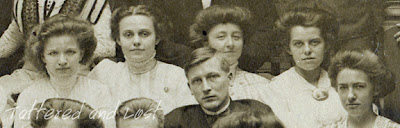
Interesting that the older women, I'm assuming the house mothers, didn't go in for the Gibson Girl look. Now, as to the house "father" in the background....

9/9/11

Deconstructing PHI TAU HOUSE PARTY in 1909


I give you, according to what is written on the back of the photo:
Phi Tau House Party
State College Commencement June 11-16 , 1909
This was at Pennsylvania State College according to a pillow one woman is holding. There are a few names written on the back, but nothing specifically corresponds with the image.


Click on image to see it larger.

I've owned this photo for close to 40 years. I used to have it stuck on my wall before I ever thought of these photos having any value; they were merely something to look at.

Over the coming days I will do what I often do with group photos...deconstruct it. Small portions of the image will be shown before "unveiling" the full image. I find it easier to take in the whole by looking at the few.

As far as the Phi Tau house, Wikipedia lists it as a coeducational fraternity at Dartmouth College founded in 1905. There is no mention of a house at Penn State. I now see a Tau Phi at State, but no Phi Tau. (Okay, just typing that has me thinking of the line in the old Bob Newhart show, "More goo to go." Never mind. It had to do with a bunch of drunks ordering Chinese food on Thanksgiving.)

2/7/11

The LADIES OF HYDE PARK and C. S. PIERSAULL


I purchased this photo many years ago from an eBay seller in New York state. I've always found it fascinating.


Click on image to see it larger.

The wealthy woman knitting while her three precocious children sit still long enough to be photographed. And who are the two women in the back? Relatives or employees? I have no information as to any of their identities other than the pencil scrawls on the front.

As to the photographer, well, this gets a little interesting. Unlike most photographers who went in for stylish typefaces for their identity this photographer's name, C. S. Piersaull, is barely readable. In no way is he drawing attention to himself or his work. Fortunately President Roosevelt recognized his value.

Over 300 of Mr. Piersaull's photos reside in the Franklin D. Roosevelt Presidential Library. The following from their site:
Who Was Charles Slyvester Piersaull?

Little is known about Charles Sylvester Piersaull. He was born in 1853 and was married to Josephine Susan Aldrich. The local registry lists his occupation as "Fishmonger" and the sign on his house says "FISH MARKET," but he did more than just sell fish. Piersaull served as the local pharmacist, bicycle repairman, and photographer. As a photographer, Charles Piersaull made his mark by leaving a rich visual record of Hyde Park's past. He took hundreds of photographs of the people, buildings, and culture of Hyde Park at the turn of the 20th century. At the time of his death in 1921, Piersaull's pictures were not taken seriously, but when they resurfaced over 20 years later, President Roosevelt immediately saw their value in understanding Hyde Park's history. The photographs were acquired by the FDR Library in 1943. (SOURCE: FDR Library)
I also found a book called Hyde Park on the Hudson by Margaret Logan Marquez that contains the page shown below. Click on the title link above to go to the book where you'll see several photos taken by Mr. Piersaull.


Click on image to see it larger.

Too often I find either nothing or very little about a photographer from so long ago. This is a rare find to see both the photographer and his wife.

Either the weeks are getting shorter or Sepia Saturday is starting earlier.

2/5/11

The UNKNOWN CHILD and B. F. HOWLAND


This image comes from the collection my friend Bert gave me. There is no information given other than what is on the back by the photo studio.


Either this was a very precocious child or it's an actor. I say "it" because I'm just not sure if it is a boy or girl. I'm leaning towards girl, but then again the clothing seems a bit theatrical, as does the hair which is wild looking for the time.

I'm dating this photo at around the late 1870s because of the information I've found about the photographer, B. F. Howland.

Benjamin Franklin Howland was born on March 1, 1828 in New Bedford, Massachusetts. He died in Oakland, California on August 6, 1900. During this span of years he appears to have led an interesting life, crisscrossing the country numerous times. Married twice, his first wife died shortly after their marriage in Massachusetts in 1854. He married his second wife on December 10, 1865 in California. They had eight children of which four were still alive upon Howland's death.

As a child he went on adventurous sailing voyages with his father, a captain of whalers and merchant ships. He worked as an engraver, did a bit of mining, running mule trains, and of course photography studios on both sides of the country.

Read the bio information below which is from the book Pioneer Photographers of the Far West: A Biographical Dictionary, 1840-1865.


Here is an ad for his studio in Syracuse, New York which he ran from around 1857 to 1864.


(SOURCE: Fulton History)

By 1865 he was back in California. He had previously gone to California in 1851. Because of all his moving you will find portraits he took in various collections all over the country with different addresses for various studios.

Fascinating to think of this adventurous man taking the portrait of this child who looks to be a bit of a wild one.

Here are two other photos taken by Howland: here and here.

We'll never know the story about this child. And so it goes for another Sepia Saturday post.

12/7/10

A bundled WOMAN OF MYSTERY


Raise your hand if you remember Rosa.

Okay, 1…2…3…sorry, I can't tell if you in the back have your hand raised or are swatting flies.

I thought it time to bring Rosa back for a few days.

Rosa in the snow. Not the first time I've shown her in snow, but that's at the end of this post.

Click on image to see it larger.

I have no idea where this was taken. Obviously not at her home in National City, California. Rosa is a woman of mystery.

If you remember, Rosa was from France, an immigrant to this country. She was married to Rodrique. To see the older posts click on the following links:


And a little surprise for those who have been following along here for the past few years. I posted a shot of Rosa long before I did the lengthy post. You can see that image here.

12/3/10

WE STAND IN THEIR SHOES


When faced with a box full of photos of unknown people and events what is your eye drawn to? A hodgepodge of images, mostly of people just standing center frame staring at the photographer. Do you buy them or toss them back?

I look back on some of the things I have bought and think "What the heck?" My taste has become more refined over the years. I can't say what I buy would be a must have purchase for someone else.

Okay, it's a given that if someone is cutting a cake I'm grabbing it. It's a category. I must find more.

But how to explain this snapshot? The people are slightly blurred. The location is nothing special. So why not toss it back into the pile?


Because of the woman's smile. All of the rest of the weaknesses in the photo disappeared to me once I focused on the woman's smile. She is the story.

Is she looking at the gentleman with love or laughing at a joke?

If you're a collector I think you'll understand this. For each collector it's that certain "something" that draws us in, whether or not anyone else goes on the journey.

I never buy with the idea that any of it will be of monetary value. I am simply stepping into another world for a moment and frankly I could care less if anyone else follows. For this moment I am the eyes of the photographer. I stand in their shoes.

And that folks is my Sepia Saturday entry for the week.

11/30/10

The SOLDIER AND THE LADY


I find this photo fascinating for a few reasons.

The photo is in a frame and unfortunately the front of the image is now glued to the glass. There's no way I know of to remove the image without damaging it. So it will always be stuck going through life with a cheesy dime store metal frame.

Click on image to see it larger.

The second thing that interests me is the fellows uniform. Anyone have any idea what it is? There's something Russian looking about the couple, but I could be wrong. I'd certainly be fascinated to hear what others think.

And then there's the woman with the heavy framed glasses without stems. Imagine keeping those on your nose all the time without your ears doing any of the heavy lifting.

What was their history? Did he go to war? Did he return? Were there children? All that information is lost with time.
_______

If you don't read my other blog, Tattered and Lost Ephemera, the ¡Viva Fiesta! image in the left margin will seem out of place on a photography blog. So to find out a little bit of history about it click here.

11/29/10

The LADIES OF THE LEAVES


Beyond grabbing some leaves to cover themselves, what is the significance of leaves in this photo? Yesterday Forgotten Old Photos featured a photo of a couple of "gentlemen" holding leaves. I know I have others. So what gives with the leaves? Strange mystical cult? Gardners? Adam and Eve thespians? If you have a clue do pass it along.

Click on image to see it larger.

Besides the leaves the obvious question is what was cut off the left side? Was there a grouping of three fellas holding bags of dirt? A cow that had wandered into the shot? Again, you can say it with me...we'll never know.

Another fine vernacular photograph from Bert's collection.

11/27/10

DON'T LET YOUR BABY Drink and Drive


I'm thinkin' maybe these adults are not a good influence on this here youngin'. A baby with a can of brew?

Click on image to see it larger.

This shot is from the Three Buck Big Box of Photos. If this photo originally belonged to Margaret she didn't write anything on the back. I guess really, what could she say?

And if you've been following this blog you may recognize the fellow on the right as one of the beer drinking guys in Ray Witt's backyard. This guy is lovin' himself some beer.

_____