Showing posts with label seaplane. Show all posts

10/25/13

SEAPLANES take flight


In honor of Sepia Saturdays 200th post anniversary I am reposting this from April 14, 2012. From what I've been able to figure out I first posted on Sepia Saturday in 2010. I have not been a consistent regular, and when I'm away from it I do miss it. 

So thank you to Alan Burnett and Kat Mortensen for creating this meeting place. May it go on and evolve for years to come as a place where folks from around the world gather for show and tell.

As to a bio of myself...let's just say I'm a book designer who lives in Northern California with a love of old photos. I, along with the images I collect, am tattered and lost.

All of the images below were taken by my father who maintains all copyrights.
__________________________________________________

A plethora of flight images for this week's Sepia Saturday.

In the late 1940s and during the Korean War my father flew seaplanes as a Naval aviator.

These first shots in black and white were taken in San Diego of a PBM utilizing JATO packs for take off. You can see the JATO rockets on the side of the plane. There were two on each side and a pilot could activate one on each side or all four at once. JATO stands for jet-fuel assisted take off. Click here to read about JATO.
The Martin PBM Mariner was a patrol bomber flying boat of World War II and the early Cold War period. It was designed to complement the Consolidated PBY Catalina in service. A total of 1,366 were built, with the first example flying on 18 February 1939 and the type entering service in September 1940. (SOURCE: Wikipedia)
Click on any image to see it larger.


You can see the JATO packs in this shot.


To see a shot of a PBM in for service click here.

The second group of shots are of P5M’s in Iwokuni, Japan. I have no idea who any of the people are.

Click on any image to see it larger.


The Martin P5M Marlin (P-5 Marlin after 1962), built by the Glenn L. Martin Company of Middle River, Maryland, was a twin-engined piston-powered flying boat entering service in 1951 and serving into late 1960s in service with the United States Navy for naval patrol. It also served in the U.S. Coast Guard and with the French Navy. 285 were produced overall. (SOURCE: Wikipedia)
Click on any image to see it larger.

P5M approaching tender.


P5M refueling.


Stern of tender.
During the Second World War, both the American and the Japanese Navies built a number of seaplane tenders to supplement their aircraft carrier fleets. However, these ships often had their catapults removed, and were used as support vessels that operated seaplanes from harbours rather than in a seaway. These aircraft were generally for long range reconnaissance patrols. The tenders allowed the aircraft to be rapidly deployed to new bases because their runways did not have to be constructed, and support facilities were mobile much like supply ships for submarines or destroyers.
The German navy in World War II did not operate any seaplane tenders. However, the German air force, Luftwaffe, had 19 seaplane tenders of both large and small sizes in operation. These ships were mostly converted from existing civilian seaplane tenders, and were capable of carrying 1-3 seaplanes. The French and Italian navies also had seaplane tenders in service.
Seaplane tenders became obsolete at the end of the Second World War. A few remained in service after the war but by the late-1950s most had been scrapped or converted to other uses such as helicopter repair ships. (SOURCE: Wikipedia)
To see another post about a P5M click here.

Over the years I’ve heard my father tell a lot of seaplane stories; one event during the Korean War in which only two planes took part is even mentioned in a book. The only one of his planes I was ever on was a P5M. I was a little girl and it was a huge plane. A vivid memory I'll have forever.

To see more about planes visit my other site, Tattered and Lost Ephemera, where I have been featuring vintage trading cards from the late 1950s entitled "Defenders of America".

4/13/12

SEAPLANES take flight


A plethora of flight images for this week's Sepia Saturday.

In the late 1940s and during the Korean War my father flew seaplanes as a Naval aviator.

These first shots in black and white were taken in San Diego of a PBM utilizing JATO packs for take off. You can see the JATO rockets on the side of the plane. There were two on each side and a pilot could activate one on each side or all four at once. JATO stands for jet-fuel assisted take off. Click here to read about JATO.
The Martin PBM Mariner was a patrol bomber flying boat of World War II and the early Cold War period. It was designed to complement the Consolidated PBY Catalina in service. A total of 1,366 were built, with the first example flying on 18 February 1939 and the type entering service in September 1940. (SOURCE: Wikipedia)
Click on any image to see it larger.


You can see the JATO packs in this shot.


To see a shot of a PBM in for service click here.

The second group of shots are of P5M’s in Iwokuni, Japan. I have no idea who any of the people are.

Click on any image to see it larger.


The Martin P5M Marlin (P-5 Marlin after 1962), built by the Glenn L. Martin Company of Middle River, Maryland, was a twin-engined piston-powered flying boat entering service in 1951 and serving into late 1960s in service with the United States Navy for naval patrol. It also served in the U.S. Coast Guard and with the French Navy. 285 were produced overall. (SOURCE: Wikipedia)
Click on any image to see it larger.

P5M approaching tender.


P5M refueling.


Stern of tender.
During the Second World War, both the American and the Japanese Navies built a number of seaplane tenders to supplement their aircraft carrier fleets. However, these ships often had their catapults removed, and were used as support vessels that operated seaplanes from harbours rather than in a seaway. These aircraft were generally for long range reconnaissance patrols. The tenders allowed the aircraft to be rapidly deployed to new bases because their runways did not have to be constructed, and support facilities were mobile much like supply ships for submarines or destroyers.
The German navy in World War II did not operate any seaplane tenders. However, the German air force, Luftwaffe, had 19 seaplane tenders of both large and small sizes in operation. These ships were mostly converted from existing civilian seaplane tenders, and were capable of carrying 1-3 seaplanes. The French and Italian navies also had seaplane tenders in service.
Seaplane tenders became obsolete at the end of the Second World War. A few remained in service after the war but by the late-1950s most had been scrapped or converted to other uses such as helicopter repair ships. (SOURCE: Wikipedia)
To see another post about a P5M click here.

Over the years I’ve heard my father tell a lot of seaplane stories; one event during the Korean War in which only two planes took part is even mentioned in a book. The only one of his planes I was ever on was a P5M. I was a little girl and it was a huge plane. A vivid memory I'll have forever.

To see more about planes visit my other site, Tattered and Lost Ephemera, where I have been featuring vintage trading cards from the late 1950s entitled "Defenders of America".

6/23/11

AIRLINES used to be fun


I'm glad to be old enough to remember what flying on commercial airlines used to be like. You dressed up and you behaved yourself. Flights took longer, but you were treated with respect and not spam in a can. These days I'll do everything I can to avoid flying. The airlines stink and too often so does the person you're sitting next to. Yes, I'm glad I have my memories, my vinyl Pan Am bag, my little United wings, old TWA folders, my postcards, etc.

The worst flight I ever took was from the West Coast to Dulles. It took over 32 hours. These days, that's normal. How the mighty have fallen, which brings me to these vintage snapshots of planes.

This weeks Sepia Saturday image shows two people working on an aircraft engine which logically made me think of vernacular photographs I have of people traveling by plane.

These first three photos all show a man by the name of Mr. Roberts who led a fascinating life. I've posted images of him in the past. I have been told what this first seaplane is, but now I can't remember so I'm open to suggestions.

Click on any image to see it larger.


The image above shows Mr. Roberts about to fly with Century Air Lines on a Stinson Tri-Motored 10 passenger plane. On the back it says "September 1931." To see a 1932 brochure from Century click here. They even provided chauffeured transportation to and from the airport. Imagine that?

Century Air Lines was formed in 1930 by Errett Lobban Cord who seems to have had his fingers in many pies.
In the final week of 1930, Cord announced the formation of Century Air Lines, Inc. an air-mail and cargo carrier based out of Chicago. Simultaneously, Stinson Aircraft announced the $3 million sale of 100 Lycoming-powered airliners to Century.

In early 1932, Aviation Corp., (AVCO) the parent company of American Airways, launched a hostile takeover of Cord’s Century Airlines by creating a labor dispute with Century’s pilots. Cord was not amused and spent the next few months secretly purchasing large chunks of Aviation Corp. stock.

At AVCO's fall board meeting, its directors were unpleasantly surprised to learn that Cord was now Aviation Corp’s majority stockholder (34%), which effectively gave him control over Century and American. On August 3, 1933 Cord purchased the New York Shipbuilding Corp. of Camden, New Jersey, and two weeks later purchased a controlling interest in the Kalamazoo, Michigan-based Checker Cab Co. (SOURCE: Coachbuilt)
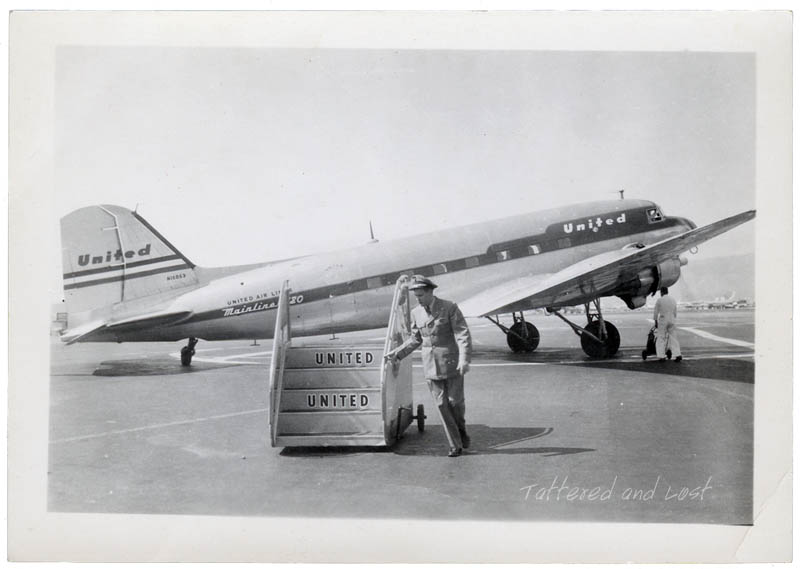
I have no idea when the shot below was taken, but geez, even the ground crew is dressed up and they probably didn't rifle through your luggage stealing whatever took their fancy. And if that's the pilot dragging the steps away who's flying the plane?


The image below is from a photo album of a trip a couple took between June 27-July 15 in 1954.


And this is a photo I have posted before. Click here to see the fascinating response I received after posting it.


Like I said, people used to dress up to fly. Flying was an adventure, not a chore.

3/23/11

PBM in for service in Oppama, Japan, in 1950


The title pretty much says it all. This was my father's PBM, a seaplane, docked for service at Oppama, Japan in 1950. They were in getting their 220 hour major overhaul.

I'm sure it's just me, but I'm waiting for a girl on roller skates to show up with a tray of malts and burgers.


Click on image to see it larger.

And here's my dad's crew for VP-42, crew 6 taken in Iwokuni.


Click on image to see it larger.

On the back it says:
This is a crew picture taken at Iwokuni just before we sent the plane over the side.
And from Wikipedia, a little about the PBM:
The Martin PBM Mariner was a patrol bomber flying boat of World War II and the early Cold War period. It was designed to complement the PBY Catalina in service. 1,366 were built, with the first example flying on February 18, 1939 and the type entering service in September 1940.

The first PBM-1s entered service with Patrol Squadron FIFTY-FIVE (VP-55) of the United States Navy on 1 September 1940. Prior to the outbreak of World War II, PBMs were used (together with PBYs) to carry out Neutrality Patrols in the Atlantic, including operations from Iceland. Following the Japanese Attack on Pearl Harbor, PBMs were used on anti-submarine patrols, sinking their first German U-Boat, U-158 on 30 June 1942. In total, PBMs were responsible, wholly or in part, for sinking 10 U-Boats during World War II. PBMs were also heavily used in the Pacific, operating from bases at Saipan, Okinawa, Iwo Jima and the South-West Pacific.

The United States Coast Guard acquired 27 Martin PBM-3 aircraft during the first half of 1943. In late 1944, the service acquired 41 PBM-5 models and more were delivered in the latter half of 1945. Ten were still in service in 1955, although all were gone from the active Coast Guard inventory by 1958 when the last example was released from CGAS San Diego and returned to the US Navy. These flying boats became the backbone of the long-range aerial search and rescue efforts of the Coast Guard in the early post-war years until supplanted by the P5M and the HU-16 Albatross in the mid-1950s.

PBMs continued in service with the US Navy following the end of World War II, flying long patrol missions during the Korean War. It continued in front-line use until replaced by its direct development, the P5M Marlin, with the last USN squadron equipped with the PBM, Patrol Squadron FIFTY (VP-50), retiring them in July 1956.(SOURCE: Wikipedia)

7/29/10

P5M offshore at IWOKUNI, JAPAN


Here's a slide from one of my father's many boxes of slides he took during the 1950s through '70s. I've said before that he was a Naval aviator. He flew off carriers and flew seaplanes like the one shown below. The call sign for this plane would have been Sugar Fox 3, and it was in squadron VP-48.


This shot is of a P5M and was most likely taken off the coast of Japan at Iwokuni around 1954. It's believed that only one of these planes still exists. It resides at the National Museum of Naval Aviation in Pensacola, Florida.
The Martin P5M Marlin (P-5 Marlin after 1962), built by the Glenn L. Martin Company of Middle River, Maryland, was a twin engined piston powered flying boat entering service in 1951 and serving into late 1960s in service with the United States Navy for naval patrol. It also served in the U.S. Coast Guard and with the French Navy. 285 were produced overall.

Built as evolutionary successor to the PBM Mariner, it had better engines, improved hull form, and more conventional tail. The XP5M Marlin prototypes were based on the last PBM-5 Mariners, the company designation being Model 237. It would be heavily improved again leading to the P5M-2 (Model 237B), which was redesignated SP-5B. A number of P5M-1 models were also used for training, designated TP-5A (after 1962).

The Marlin was designed as a gull-winged aircraft to place the engines and propellers high above the spray. Power was by two Wright R-3350 radial engines. The rear hull did not lift sharply from the water at the tail, instead rising up steadily, a Martin innovation; this gave the aircraft a longer base of flotation and reduced "porpoising" over waves.

The prototype had nose and tail turrets with twin 20 millimetres (0.79 in) cannon in each, as well as a dorsal turret with two 0.5 in (12.7 mm) M2 Browning machine guns. The cockpit area was the same as the Mariner's. It first flew in 30 May 1948.

The first of 167 production P5M-1 aircraft was produced in 1951, flying on 22 June 1951. Changes from the prototype included a raised flight deck for improved visibility, the replacement of the nose turret with a large radome for the AN/APS-44 search radar, the deletion of the dorsal turret, and new, streamlined wing floats. The engine nacelles were lengthened to provide room for weapons bays in the rear.

The P5M-1 was followed by 116 P5M-2 planes. These had a T-tail to put the tail surfaces out of the spray, a AN/ASQ-8 MAD boom at the rear of the tail-tip, no tail guns, better crew accommodation and an improved bow to reduce spray during takeoff and landing. (SOURCE: Wikipedia)
My father gets a big smile when he sees this plane. And he still has a model of the one he flew, the only one of his planes I ever was able to see in person. I got to stand on some stairs and look in a door. That was it. I wasn't allowed inside. Let's just say, it was BIG and created an indelible memory.