Showing posts with label airplanes. Show all posts

3/22/12

World War II PLANE WRECKAGE, NEW GUINEA


Continuing with photos from World War II from my Uncle Roy’s collection from New Guinea.

Click on image to see it larger.

I have no information about this plane wreckage. Is it an American plane that was taken out during a Japanese bombing of New Guinea? Was it shot down? Probably no way of knowing. Not even sure it was on New Guinea.

It’s from our past. It’s war. It’s part of our present and future.

3/21/12

JUNGLE SKIPPER in World War II


In December of 2010 I posted a few photos from my great Uncle Roy's collection. He served in the Seabees in World War II and died in 1958. You can find the posts by clicking on "Uncle Roy" in the labels below. You'll see an interesting photo of parachutists, some vintage plane nose art, and a couple of Seabees.


I know nothing about any of his photos, but this one is quite curious. Uncle Roy served at least part of the time in New Guinea. I don't know if this was taken there, nor do I know who the fellow is in the photo.

The Jungle Skippers were officially known as the 317th Troop Carrier Group. The following is a portion of a speech given by Jim Timmons, Vice President of the 317th Veteran's Group, in September 2005. Click on the source link at the end to read the entire speech.
The Jungle Skippers were the squadrons of the 317 th Troop Carrier Group. They were the 39th, 40th , 41st, and 46th Troop Carrier Squadrons. They served in the South Pacific Theater of operations under the 5th Air Force commanded by General George Kenny. The squadrons were activated at Duncan Field, Texas in Feb. 1942. They trained at Army airfields across the United States . This included training in troop drop operations at Lawson Field in Ft. Benning , GA. and glider towing training at Grenada , Mississippi . After completion of training they were deployed to Townsville , Australia in Jan. of 1943. They went right to work flying troops and supplies from Australia to Port Moresby , New Guinea . Their baptism of fire came that same month in New Guinea . The Australians were desperately trying to hold on to a vital airstrip at Wau. The Japanese were close to over running the Aussies. The 317 th flew in much needed reinforcements, ammunition and artillery. The Wau airstrip was a difficult airstrip to land on even without a battle going on. The strip was uphill; it rose one foot for every twelve feet. To make matters worse there was a crescent shaped mountain at the end of the runway making a last minute go around impossible. Despite this, over sixty landings were made on that first day. There was machine gun and sniper fire at the first aircraft in, and the reinforcements left the planes with their guns firing to silence the Japanese guns. The battle for Wau was won and the Japanese were pushed further back into the jungle. (SOURCE: USAF 317 Vet)
You'll notice that the 39th, 40th, 41st and 46th squadrons are mentioned, not the one shown here with "44" on the side. So that's the mystery. Was it really one of the Jungle Skippers?

Click on image to see it larger.

Wikipedia has this about the Jungle Skippers:
Formed at Duncan Field, Texas, on 22 February 1942. The group's humble beginning consisted of eighteen enlisted men and one Captain which formed the entire unit. Moved to Australia, December 1942 – January 1943, and assigned to Fifth AF. the 317 Troop Carrier Group (TCG) was the second airlift group to arrive in the Southwest Pacific Theater during World War II.

Operated in New Guinea for a short time early in 1943. Received a DUC for making numerous flights in unarmed planes over the Owen Stanley Range, 30 January – 1 February 1943 to transport reinforcements and supplies to Wau, New Guinea, where enemy forces were threatening a valuable Allied airdrome.

Exchanged its new C-47’s for a variety of aircraft in New Guinea and began operating from Australia, where the group had maintained its headquarters, Flew troops and equipment to New Guinea, established courier and passenger routes in Australia, and trained with airborne troops.

Equipped with C-47’s and moved to New Guinea in September 1943. Took part in the first airborne operation in the Southwest Pacific on 5 September, dropping paratroops at Nadzab, New Guinea, to cut supply lines and seize enemy bases. Until November 1944, transported men and cargo to Allied bases on New Guinea, New Britain, Guadalcanal, and in the Admiralty Islands. Also dropped reinforcements and supplies to US forces on Noemfoor, 3–4 July 1944.

After moving to the Philippines in November 1944, transported supplies to ground forces on Luzon, Leyte, and Mindoro, and supplied guerrillas on Mindanao, Cebu, and Panay. Participated in two airborne operations during February 1945: on 3 and 4 February dropped paratroops south of Manila to seize highway routes to the city, and on 16 and 17 February dropped the 502d Regiment on Corregidor to open Manila Bay to US shipping; received a DUC for the latter operation, performed at low altitude over small drop zones in a heavily defended area. Completed two unusual missions on 12 and 15 April 1945 when this troop carrier organization bombed Carabo Island with drums of napalm. Dropped part of 511th Regiment near Aparri on 23 June 1945 to split Japanese forces in the Cagayen Valley and prevent a retreat to the hills in northern Luzon. (SOURCE: Wikipedia)
To see other photos of Jungle Skipper planes click here. And if you stumbled upon this page and are interested in the 317th Troop Carrier Groups reunions click here.

Each day we lose more and more of the World War II vets. This past week a flying ace died who belonged to the World War II pilot's group my dad belongs to. Another has resigned himself to his fate with cancer. The verbal history will soon be gone.

UPDATE: The following was sent to me today in a comment.
The 44 on the side of the Jungle Skipper C-47 is not a squadron number. It's a Chalk Number, a temporary number put on the aircraft prior to a troop drop to identify the aircraft to the paratroopers assigned to it when multiple aircraft are used for a troop drop.
Thanks "Anonymous" for the information.
___________

New book NOW available on Amazon.
Tattered and Lost: Forgotten Dolls

This one is for those who love dolls!

Snapshots from the last 100+ years of children and adults with dolls. Okay, there are a couple of dogs too.

Perfect stocking stuffer for the doll collector on your list!


6/23/11

AIRLINES used to be fun


I'm glad to be old enough to remember what flying on commercial airlines used to be like. You dressed up and you behaved yourself. Flights took longer, but you were treated with respect and not spam in a can. These days I'll do everything I can to avoid flying. The airlines stink and too often so does the person you're sitting next to. Yes, I'm glad I have my memories, my vinyl Pan Am bag, my little United wings, old TWA folders, my postcards, etc.

The worst flight I ever took was from the West Coast to Dulles. It took over 32 hours. These days, that's normal. How the mighty have fallen, which brings me to these vintage snapshots of planes.

This weeks Sepia Saturday image shows two people working on an aircraft engine which logically made me think of vernacular photographs I have of people traveling by plane.

These first three photos all show a man by the name of Mr. Roberts who led a fascinating life. I've posted images of him in the past. I have been told what this first seaplane is, but now I can't remember so I'm open to suggestions.

Click on any image to see it larger.


The image above shows Mr. Roberts about to fly with Century Air Lines on a Stinson Tri-Motored 10 passenger plane. On the back it says "September 1931." To see a 1932 brochure from Century click here. They even provided chauffeured transportation to and from the airport. Imagine that?

Century Air Lines was formed in 1930 by Errett Lobban Cord who seems to have had his fingers in many pies.
In the final week of 1930, Cord announced the formation of Century Air Lines, Inc. an air-mail and cargo carrier based out of Chicago. Simultaneously, Stinson Aircraft announced the $3 million sale of 100 Lycoming-powered airliners to Century.

In early 1932, Aviation Corp., (AVCO) the parent company of American Airways, launched a hostile takeover of Cord’s Century Airlines by creating a labor dispute with Century’s pilots. Cord was not amused and spent the next few months secretly purchasing large chunks of Aviation Corp. stock.

At AVCO's fall board meeting, its directors were unpleasantly surprised to learn that Cord was now Aviation Corp’s majority stockholder (34%), which effectively gave him control over Century and American. On August 3, 1933 Cord purchased the New York Shipbuilding Corp. of Camden, New Jersey, and two weeks later purchased a controlling interest in the Kalamazoo, Michigan-based Checker Cab Co. (SOURCE: Coachbuilt)
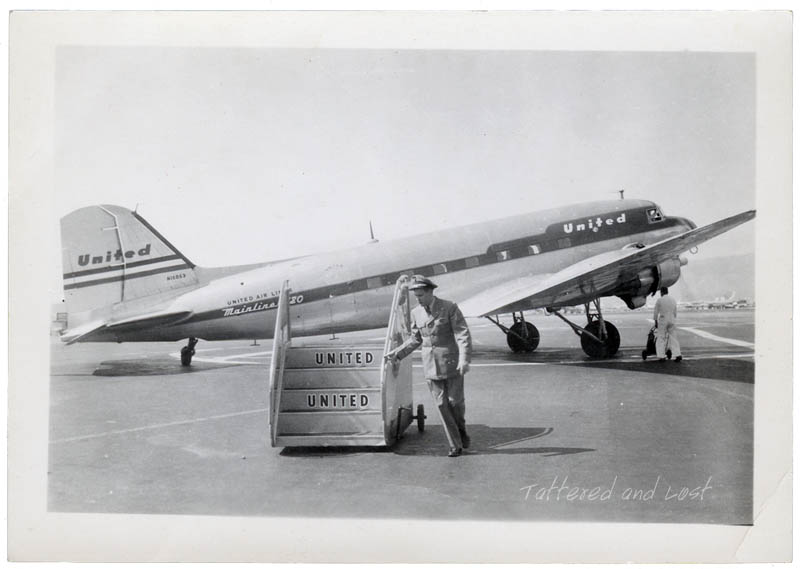
I have no idea when the shot below was taken, but geez, even the ground crew is dressed up and they probably didn't rifle through your luggage stealing whatever took their fancy. And if that's the pilot dragging the steps away who's flying the plane?


The image below is from a photo album of a trip a couple took between June 27-July 15 in 1954.


And this is a photo I have posted before. Click here to see the fascinating response I received after posting it.


Like I said, people used to dress up to fly. Flying was an adventure, not a chore.