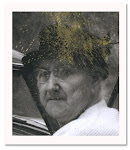
No idea where or when this shot was taken. A legit pow-wow? No idea.


_____


George D. Morrison, nicknamed Pete, was an American silent western film actor born August 8, 1890 in Westminster, Colorado. During his childhood he lived at Morrison, Colorado (named for his grandfather George Morrison) and Idaho Springs, and got his early tastes of horsemanship riding with his father Thomas during the summer. They drove cattle and sheep from the summer ranges in Middle Park and Fall River in Colorado to supply beef and mutton to the mining camps of Georgetown, Idaho Springs, Nevadaville, Black Hawk and Central City. During his mid-teens Pete worked in the mining industry, with his older brothers driving in sections of the Argo Tunnel where Pete was a motorman, hoist operator, topside helper, teamster hauler, assisting several of the larger miners in the Idaho Springs area. In the summer of 1910 Pete Morrison was an engine fireman for the Colorado Southern Railroad when he was lured away by the early western movies. Pete began working as a stunt man for the Essanay Studios of Broncho Billy films, soon discovering he could make more money working in movies in 2 weeks than he could make working for a month on the railroad. Pete followed his older brother Chick Morrison to California, where he also became a star in early western pictures. Through his career, Morrison transcended from very early film in 1909 to sound in 1935 starring in some 132 pictures. (SOURCE: Wikipedia)
Buck Jones (December 12, 1891 – November 30, 1942) was an American motion picture star of the 1920s, 1930s, and 1940s, best known for his work starring in many popular western movies. In his early film appearances, he was billed as Charles Jones.
Charles Frederick Gebhart was born on the outskirts of Vincennes, Indiana on December 12, 1891. (Some sources erroneously indicate December 4, 1889, but Jones's marriage license and his military records confirm the 1891 date.)[2] In 1907, Jones joined the US Army a month after his sixteenth birthday: his mother had signed a consent form that gave his age as eighteen. He was assigned to Troop G, 6th Cavalry Regiment, and was deployed to the Philippine islands in October, 1907, where he served in combat and was wounded during the Moro Rebellion. Upon his return to the U.S. in December, 1909, he was honorably discharged at Fort McDowell, California.Here we have an old Buck Jones movie from 1931 which also includes a young John Wayne.
Following his military service, he began working as a cowboy on the 101 Ranch near Bliss, Oklahoma. While attending equestrian shows he met Odille "Dell" Osborne, who rode horses professionally. The two became involved, and married in 1915. Both had very little money, so the producers of a Wild West Show they were working on at the time offered to allow them to marry in an actual show performance, in public, which they accepted.
While in Los Angeles, and with his wife pregnant, Jones decided to leave the cowboy life behind and get a job in the film industry. He was hired by Universal Pictures for $5 per day as a bit player and stuntman. He later worked for Canyon Pictures, then Fox Film Corporation, eventually earning $40 per week as a stuntman. With Fox his salary increased to $150 per week, and company executive William Fox decided to use him as a backup to Tom Mix. This led to his first starring role, The Last Straw, released in 1920. (SOURCE: Wikipedia)

 Bonnie Gray Harris (1891-1988)
 The following are all from Cowgirls: Women of the Wild West by Elizabeth Clair Flood.
“If one loves a thing and does it well, why shouldn’t se do it?” said Bonnie Gray to her disapproving family. Her parents had high hopes for their daughter, who had a college degree in music and was a fine pianist. But Gray’s love for competitive sports lured her into the rodeo world of the Cheyenne Frontier Days, Oregon’s Pendelton Round-up, the Calgary Stampede, and New York’s Madison Square Garden.
Bonnie Gray earned money jumping her horse King Tut over an automobile filled with passengers.
Despite the broken bones and the long hours on the road, many of the early cowgirls admitted that rodeo in the ‘teens and 1920s was glamourous. When asked what motivated her to live such hard life, Bonnie Gray answered: “Oh honey, I loved it. I was tops in the and tops in the that. I just loved being tops!”
Some cowgirls did make reasonable amounts of money. Bonnie Gray, who often substituted for cowboys Bing Crosby, Hoot Gibson, and Buck Jones, earned $10,000 for jumping a horse over a pile of brush and down a ten-foot cliff. The horse landed such that the stirrup straps broke and Gray sustained a backward fall. She commented that she would never do the stunt again, but few who knew her were convinced. “I used to ride to Beverly Hills and practice my stunts on Will’s (Will Rogers’s) front lawn," Gray said.
 If I hadn’t figured out how to get the old black album paper off the back of this shot I’d have never known that this was one fascinating woman sitting astride that fabulous horse. To read a bit more about Bonnie Gray click here. And I have listed two wonderful books about cowgirls in the Amazon column to the left. They're full of photos and ephemera making you wish you'd never thrown your old six-shooter and boots away...providing you remember those days as a kid.


One of her first projects was Hopi House, a hotel at the Grand Canyon, where she based her design on a pueblo structure.
She tried to make her building authentic by hiring Hopi Indians and learning about Hopi culture. (SOURCE: The Wild West)
Fame is coming belatedly to American architect and designer Mary Colter (1869-1958), and this illustrated volume is the most detailed study of her career to date. If her name is not well known, her work certainly is. Colter was an employee of the Harvey Company from 1910 to 1948, and her main task was the design and decoration of Harvey hotels and restaurants along the Santa Fe Railway. A versatile designer who integrated authentic regional elements into strong themes, Colter was responsible for famous hotels such as El Navajo in Gallup, NM; La Posada in Winslow, AZ; and Painted Desert Inn in Painted Desert, AZ. Her rustic-styled buildings at the Grand Canyon, including the Hopi House, Bright Angel Lodge, and others, influenced National Park Service development, and the style became known as National Park Service Rustic. This sympathetic and well-documented book by Berke, an editor at Preservation magazine who also writes on historic architecture, includes new photographs. The final chapter describes the fates of many Colter buildings, including the restoration of some survivors. Recommended for regional public and academic libraries. —David R. Conn, Surrey P.L., BC


 Posts
All Comments
Posts
All Comments