Showing posts with label cemetery. Show all posts

11/4/16

Lost and ALONE, but NOT FORGOTTEN


This is a repost from 2009. It is my submission for Sepia Saturday's remembrance of World War I. I reference two online folks who were able to fill in some of the lost information about the photo. One of them, Eloh, has been missing in action for many years from her blog. At some point someone has gone in and deleted all the very funny stories she told.

I again thank both of them for providing the information they did.

And I do recall that a writer from Wisconsin or Michigan—I can't remember—contacted me about using the photo in a story she was writing for a local paper. I was told I'd be sent a link to the article. Of course I never was. It's happened many times that I've given folks permission to use something with the stipulation they eventually either send me a copy of the book or a link to the piece. Too often they simply don't follow through with their side of the deal.
_____

I have no information about this photograph. I don't know if this World War I graveyard is stateside or in Europe. It's sad, mysterious, and just plain interesting. Nothing is written on the back. Perhaps someday someone will stumble across it in Flickr who knows something about it.

World War I cemetery_tatteredandlost
Click on image to see it larger.

List of names that I was able to clearly read:
  1. Charles A. Vogt / Pvt 50Co.T.C. 17 Grand Div / Died 1919
  2. Charles J. Vallier Jr. / Sgt. 311 Engrs  / Died Mar. 6. 1919
  3. John C Zitzmann / Col or Sgt Heqrs Co 312 ??? / Died Oct. 13. 1918
  4. Macgo Alston / Pvt CoD 304 Labor ??? / Died Jan. 6. 1919
  5. Robert Illig / Pvt Co A 38 Engrs / Died 
  6. Edward P Bowe?? / Wagoner
  7. Clarence V. Fanning / Pvt Co D 312 Engrs / Died Jan. 7. 1919
  8. Michael J Connolly / Pvt Hdqs Co ??? / Died ??? 
  9. Walter C Skole / Mechanic CoG 344 Inf / Died ???
  10. Albert C. Welch / Sgt. CoF 348 Inf / Died Feb. 5. 1919
  11. Ernest Bisbee / Wagoner Sply Co 348 Inf / Died Nov. 4. 1918
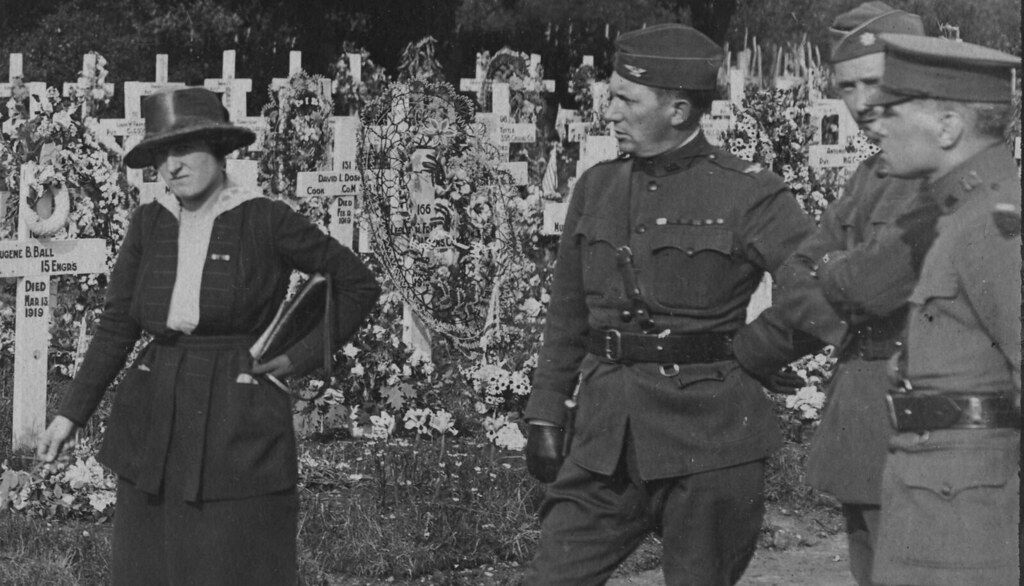
  12. Eugene B. Ball / Corpl 15 Engrs / Died Mar. 13. 1919 
  13. David L Dosh??? / Cook CoM ??? / Died Feb. 9. 1919
To see the people in the photo even larger click here.

Update: The net is an amazing place. This photo can now be put into context with the world. Eloh, from the hysterically funny blog http://elohssanatahw.blogspot.com/, and Lori, a genealogist from http://www.familytreesmaycontainnuts.com, together filled in the pieces. I present to you their findings.

From Eloh:
I looked at the larger photo, wow, there is some "silent film" going on isn't there. A whole movie in the expressions and body language.

The woman, possibly Graves Registration? She's wearing what seems to be a campaign ribbon on her lapel. It could be a flower stem or a pencil in her right hand and it looks like papers between her purse and body.  I'm stumped with the pockets both full of hankies. They could be scented, but the exhumed remains really wouldn't be that stinky.  Maybe she just has a heart, maybe fashion?

The full bird colonel is obviously upset with her. He is used to getting things his way.  On his collar is the Engineer insignia and the Combat Infantrymans. Color is a problem with the rank of the other two, but one thing about the Army, some things stay the same.  I'll still be guessing that the oak leaf is gold and that Major is the Colonels' Aid. (Personal secretary).  Color problems again, and again it would normally be a silver bar of a First Lieutenant, could be a Captain at that angle of the photo, but he is young and not paying attention to his surroundings, he is only interested in what that Bird Colonel wants. He is also wearing Engineer Insignia. I can't make out the patch, left shoulder it would tell us what "Army" he was assigned to.
(7th Army has been in Europe since  WWII)

I noticed in your list of names a Junior and thought it the most likely to connect up to something useful.  I was lucky as he did have a child.

This is a relocation of soldiers killed in France.

Charles J. Vallier Jr. / Sgt. 311 Engrs  / Died Mar. 6. 1919

Born:  10 Jul 1888  Place:  Of, Milwaukee, Milwaukee, Wisconsin
Died:  6 Mar 1919  Place:  , , , France
Wife's Name
Mae MINN

Born:  Abt. 1892  Place: 

one child listed as still living.

It will be very interesting to find out where his body is today.
From Lori:
I am pretty sure the cemetery is Suresnes, Ile de France, France. The American military cemetery at Suresnes was established in 1917 by the Graves Registration Service of the Army Quartermaster Corps. A majority of the World War I dead buried there died of wounds or sickness in hospitals located in Paris or at other places administered by the Services of Supply. (Many were victims of the influenza epidemic of 1918-1919.) The graves area consists of four burial plots: three of World War I, with a total of 1541 graves, and one of World War II, containing the graves of 24 unknown soldiers, sailors, or airmen.
At least one of the names (Ernest Bisbee) on the list is buried there. I didn’t find any family trees looking for Charles Vallier.
Thanks to both of you for helping to fill in the pieces. Perhaps someday someone looking for information about their ancestors will find this photo online.

Update: Thank you to Natalie Karst for finding and sending the following two newspaper clippings relating to Walter C. Skole in the list above. Because of her sleuthing we now know the cemetery was Carbon Blanc and that it is possible the woman in the photo is Edith Wilson, wife of President Woodrow Wilson.

It's always so rewarding when I post something and even more comes back to me than I initially posted. I can't thank those who participate enough. It's a little thread of history.

Click on images to see them larger.


To see another post about a U.S. soldier who lost his life during war please visit my link to the Sgt. C. E. Mower which now contains many new images from the shipboard newsletter from the 1940s provided by reader D. Kauffman.
_____

4/20/12

GARDENING amongst the dead


I just did a Google search for two words most of you have probably not bothered to search: garden cemetery. There are, as of this date, 17,400 entries that show up. And why did I do this search? Because this weeks Sepia Saturday theme, as I interpret it, is about gardens. See how easy it is to connect the dots?

I do have photos of people standing in home gardens posing and smiling. I think getting your photo taken in a garden is almost mandatory; we’ve all done it. But how many have posed at gravesites in cemeteries with “garden” in their name?

I think putting the word “garden” and “cemetery” together is a marketing tool. It sounds better to think of friends and family in a garden rather than say…Boot Hill.

When I was in art college I had a watercolor teacher who sent us to a local grand cemetery to paint. We were in a garden, a garden that just happened to be full of dead people with a beautiful view of the San Francisco Bay. The class scattered all over the grounds. My friend and I positioned ourselves in front of a row of mausoleums that housed the remains of some of the most important people to have ever walked the streets of San Francisco. I had a Coca-Cola bottle that I kept filled with water as I painted. There was a faucet nearby where I could refill it.

In the beginning, as we quietly painted, it didn’t bother us to be sitting in the middle of the historical dead, but then we noticed ants. A trail of ants seemed to be coming from one of the mausoleums and then pass right between us, around my Coca-Cola bottle, and on down the hill. Suddenly the place got a little creepy. Where had these ants been? It started to freak us out just ever so slightly. We went back to staring at the view, then looking at the ants, then back to the view, etc. We’d stopped talking. It wasn’t a garden anymore, it was a place full of dead people with ants. And then I felt the tap on my shoulder and about jumped out of my skin. I let out the scream first which was quickly echoed by my friend. No, it wasn’t one of the historic founders of San Francisco tapping on my shoulder telling me I was blocking their view of the Bay. It was the teacher. He seemed to really enjoy our reaction.

I went back to that cemetery many more times to paint. It is a beautiful place with a gorgeous view that just happens to be full of the dead, including a close family friend. It’s where Eleanor is. Eleanor is forever in the garden.


I have no idea who these people are. They're in a garden. And isn't it sad to think that for some the only time in their lives they are sent flowers is after they're dead.

5/7/10

CHURCHYARD OF PRINCE GEORGE WINYAH Georgetown, South Carolina


Sooner or later someone doing genealogy research is going to find this post and say "Wow! That's where my ancestor's are buried." That's what's interesting about blogging, what seems to be useless information I impart somehow ends up meaning something to someone. It's happened several times.

I have titled this post using the copy written on the back of the photo, "Churchyard of Prince George Winyah, Georgetown, S. C." I have no idea where I got this. I found it the other day in a large chest that is full of several thousand post cards.

Churchyard of Prince George Winyah_tatteredandlost
Click on image to see it larger.

It's a wonderful old cemetery with Spanish moss hanging from the trees and old headstones. Oh so perfect for a Halloween eve. Or perhaps a walk on a warm summers night with lighting bugs flitting around the moss and stones.

I did a wee bit of googling and found the following at Wikipedia about the church and cemetery. Funny thing is that I'm not finding any other photos online. That seems a bit strange considering it's historical relevance to South Carolina.
Prince George Winyah Church is an Episcopal church in Georgetown, South Carolina. Prince George Winyah is one of the oldest continuous congregations in South Carolina, and the church building is one of the oldest churches in continuous service in South Carolina. Prince George Winyah (Episcopal) and Churchyard was named to the National Register of Historic Places on May 6, 1971.

Starting in 1716, Anglican parishes were electoral and administration units in South Carolina government. Therefore, Prince George Parish and Prince George Winyah Parish can also refer to an electoral and administrative district that had the same geographic boundaries as this church.

Early History
As early colonialist spread across the South Carolina lowcountry, there was a need of a new parish north of the existing St. James Santee Parish. Prince George Parish was established on March 10, 1721. It was named after the Prince of Wales, who became King George II. There were two potential locations for the church: an inland settlement on the Black River and Winyah on the Sampit River and Winyah Bay at the location of today's Georgetown. In 1726, a wooden church was built inland on of a bend of the Black River near Brown's Ferry and twelve miles from the present Georgetown.

On April 9, 1734, the parish was divided to form St. Frederick's Parish. The wooden church was transferred to the new parish.

Prince George Winyah Church
The earliest vestry records for Prince George Winyah are January 13, 1737.A subscription campaign for a new church at Winyah was begun in 1737. This was supplemented by an import tax at the port and £1,000 from the colonial Assembly. Starting in 1740, the bricks were collected. Land was donated by William Screven, who was the first Baptist minister in Carolina, and his son Elisha Screven. Construction was begun in the mid 1750s. The cornerstone was laid in 1745.

The church was built of English red bricks with local oyster shell mortar. The cornerstone was laid on October 30, 1745. The nave has a rectangular plan with five bays. The center bays have side doors with fanlights and the others have windows with fanlights. Brick pilasters flank the side doors and are at the corners of the church. The roof is hipped over the sanctuary and has a Jacobean or Dutch gable at the entrance. The nave has a plastered, barrel-vaulted ceiling. The pews are paneled, wooden box pews. There is a center aisle and a cross aisle at the side doors. The floor is flagstone. The first service was held on August 16, 1747.

The church was occupied by British troops in the Revolutionary War. During the occupation, the church's interior was burned. Tradition also indicates that the church was used for a stable.

A chancel with a semielliptical apse and a gallery was built about 1809. A vestibule entrance with double doors and a tower was constructed in 1824. The brick tower had a square cross section topped with an octangular section with cupola and large cross. A clock and balustrated belfry is in the upper section. A Mohler organ was installed in 1850.

In 1823, Francis Huger Rutledge was ordained a deacon. He eventually became bishop of the Episcopal Diocese of Florida. In 1828, Anthony Toomer Porter, who founded Porter Military Academy in Charleston, was baptized.

On February 25, 1865, the Union Navy occupied Georgetown. The church remained open.

In 1871, the chancel furnishings were replaced and the altar was enlarged. In 1874, the church was given a bell and a clock. A stained glass window from St. Mary's Chapel at Hagley on the Waccamaw was installed.

Churchyard
The churchyard is surrounded by a brick wall and contains the cemetery. In addition to parishioners and clergy of Prince George Winyah, the cemetery has the graves of several notable South Carolinians: Paul Trapier, who was a patriot and was elected to the Second Continental Congress; James H. Trapier, who was a brigadier general in the Confederate Army, Rev. Dr. Anthony T. Porter; Capt. Roger Shackelford, born in North Carolina and among the early Shackelford family of Georgetown; and Governor Robert F. W. Allston. (SOURCE: Wikipedia)